
High blood pressure needs follow-up, not guesswork.
Stay ahead of high blood pressure before it causes complications.
Log blood pressure, catch drifting numbers early, and get doctor review, with reminders keeping follow-up consistent between visits.
What's included
- Included:BP logging via app or web
- Included:Trend view for you and your care team
- Included:Medication and follow-up reminders
- Included:Doctor review when readings drift
- Included:Doctor escalation when closer care is needed
Your path
How it works for you
What we monitor
Every check, and how often
Once your doctor puts you on a hypertension care plan, here's exactly what gets tracked, and on what schedule.
Blood Pressure MonitoringThe reading itself, tracked often enough to actually see a trend.
- Home blood pressure readings
Logged via app or web; you're reminded if none comes in.
Every 3 days by default (your care team can adjust this)Reminded automatically - Structured 7-day check (HBPM)
Two readings each morning and evening for a week, the most reliable way to confirm what's really going on.
When your diagnosis or control needs confirmingFollowed by your care team
Doctor ReviewHow often your care team actually looks at how you're doing.
- Medication review
Your care team checks how your treatment is working and adjusts if needed.
Every 6 months once you're at target; every 2–4 weeks until you get thereReminded automatically
Kidney & Metabolic BloodsThe wider picture beyond the reading itself.
- Kidney function & electrolytes
Checks how your kidneys and salt balance are coping. Also automatically re-checked whenever certain blood-pressure medicines are started or changed, see below.
AnnuallyFollowed by your care team - Lipid panel
Cholesterol numbers, part of your overall cardiovascular risk picture.
AnnuallyFollowed by your care team - HbA1c
A blood sugar check, since high blood pressure and diabetes often travel together.
AnnuallyFollowed by your care team
If You're Prescribed These, We Track Them AutomaticallyCertain blood-pressure medicines carry their own lab checks, scheduled the moment they're prescribed.
- ACE inhibitors (e.g. ramipril, lisinopril)
Kidney function and potassium, checked shortly after you start.
About 2 weeks after startingReminded automatically - ARBs (e.g. losartan, telmisartan)
Kidney function and potassium.
Before starting, 1–2 weeks after, then every 12 monthsReminded automatically - Thiazide diuretics
Electrolytes, kidney function, and glucose.
Before starting, about 4 weeks after, then every 12 monthsReminded automatically - Potassium-sparing diuretics (e.g. spironolactone)
Potassium and kidney function, watched closely at first.
Before starting, 1–2 weeks after, then every 6 monthsReminded automatically - Statins, if prescribed alongside
Checks how well your cholesterol is responding to treatment.
3 months after startingReminded automatically
Reminded automatically means the app itself schedules and nudges you. Followed by your care team means it's a real part of your protocol that your doctor tracks, even where the app doesn't yet send its own separate reminder.
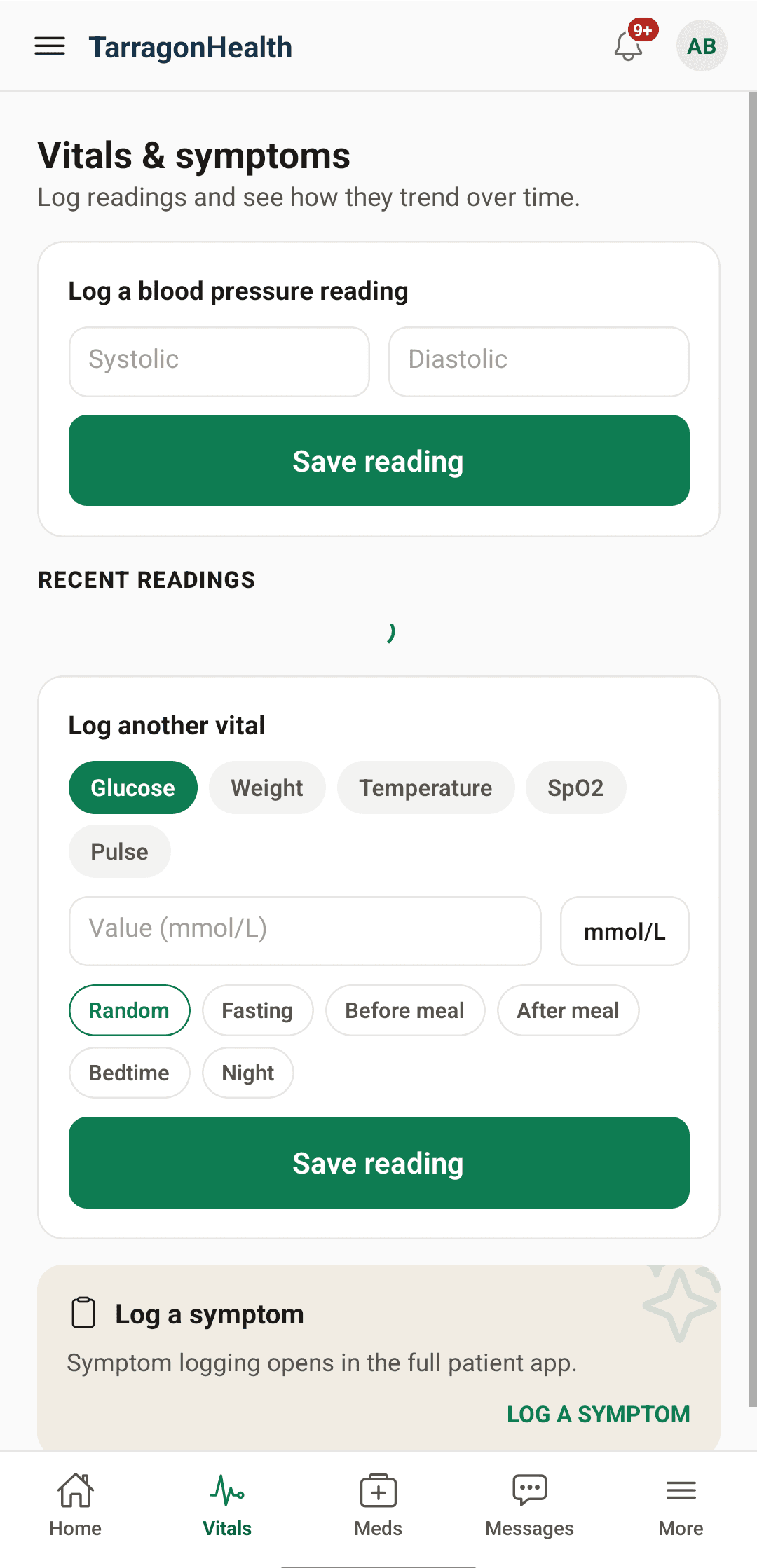
Log a reading
A blood pressure reading, logged in under a minute
Systolic, diastolic, and you're done. Every reading lands straight on your record, so your care team always has a current picture, not just whatever you remember to mention at your next check-in.
How the pieces fit together
Three different things, easy to mix up
These run alongside each other, not instead of one another. Which ones apply to you depends on your age, sex, and whether you have a diagnosed condition, not a choice you have to make.
Your Annual Health Check
One bundled lab visit, once a year: core bloodwork, organ-baseline checks, and infectious-disease screening in a single trip.
See what's in the bundleYour Screening Journey
The fuller, personal calendar: every screening recommended for your exact age and sex, each on its own real-world cycle, some every year, some every two or three, whether or not it's part of a bundle.
See your screening calendarChronic Condition Monitoring
If you're diagnosed with something like hypertension or diabetes, a separate, much more frequent set of checks, some daily, some every few months, for as long as you're on that care plan.
Explore more Blood Pressure resources

Blood pressure Article
What is a normal blood pressure, and when should you worry?
Blood pressure Article
Five changes that genuinely lower blood pressure
Blood pressure Article
How to measure your blood pressure at home, properly
Blood pressure Article
Why you shouldn't stop your blood pressure medicine when you feel fine
Blood pressure Article
Blood pressure medications explained: the main types, in plain language
Blood pressure Article
Cooking with less salt: herbs, oils and swaps for Nigerian kitchens
Blood pressure Article
Hypertension complications: what unmanaged blood pressure does to your heart, brain and kidneys
In an emergency, go to your nearest hospital
TarragonHealth is for ongoing and preventive care; it does not provide emergency treatment. If you or someone you care for has severe symptoms such as chest pain, trouble breathing, or signs of a stroke, go to the nearest hospital or call your local emergency number right away.
Ready to get started?
Join TarragonHealth and bring continuity to your care.